
Peggs vs JUST Egg: Which Plant-Based Egg Is Right for You?
If you've spent five minutes in the plant-based egg aisle, or scrolling the "egg alternatives" shelf on Amazon, you've probably run into these two names more than any others. Peggs and JUST Egg both promise to replace a conventional egg in your kitchen, and both have real fans. But they are not the same product wearing different packaging. One is a shelf-stable powder you keep in the pantry. The other is a refrigerated liquid you keep next to the milk. That single difference changes almost everything else: price, shelf life, where you can buy it, and how you use it day to day.
Here's an honest, side-by-side look at both, so you can figure out which one actually fits your kitchen.
The Short Answer
If you want something ready to shake and pour straight into a hot pan, and you have regular access to a fridge and a well-stocked grocery store, JUST Egg is the more convenient option most days. If you want something that survives a pantry shelf for a year or more, doesn't compete for fridge space, and works for both scrambles and baking without a race against a use-by date, Peggs is built for that. The rest of this guide walks through why, with real numbers.
Format and Ingredients
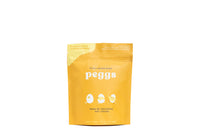
Made by chickpeas, not chicks
This recipe was made with Peggs
$36.00 — Peggs Plant-Based Egg | Vegan, Gluten-Free, Soy-Free
Peggs is a shelf-stable dry blend made primarily from chickpea flour. Per the Peggs product page, the ingredients are chickpeas, potato starch, flaxseed, nutritional yeast, black salt (kala namak), cellulose, gellan gum, baking powder, turmeric, and onion powder. To use it, you whisk 1/4 cup of Peggs with 1/4 cup of water, which substitutes for two eggs, then cook or bake as you normally would.
JUST Egg, made by Eat Just, Inc., is a refrigerated liquid built around mung bean protein, water, and expeller-pressed canola oil, along with a handful of stabilizers and colorants. Retailer-listed nutrition panels also show gellan gum, tapioca syrup solids, and a small amount of preservative among the minor ingredients, so it's worth checking the label on the bottle you actually buy, since formulations do get refined over time. JUST Egg ships ready to shake and pour, with no mixing step required.
The practical difference in your kitchen: Peggs needs water and a whisk before it hits the pan. JUST Egg needs a fridge and a shake.
Price Per Egg
Peggs |
JUST Egg |
|
|---|---|---|
Format |
Shelf-stable powder |
Refrigerated liquid |
Pack size |
36, 60, or 96 egg equivalents per pouch |
16 oz bottle (about 10 servings) |
Starting price |
$36.00 (36-egg pouch) |
$6.96–$8.49 for 16 oz, depending on retailer |
Price per egg |
$1.00 (36-pack) down to $0.78 (96-pack) |
Roughly $0.70–$0.85 |
Refrigeration |
Not required, ever |
Required at all times |
Where sold |
eatpeggs.com, Amazon |
Amazon, Walmart, Target, Kroger, Costco, Whole Foods, Instacart, Thrive Market |
Peggs pricing above is pulled directly from the current Peggs Shopify store. JUST Egg pricing is a snapshot of Target, Kroger, and Walmart listings for the standard 16 oz bottle; retail prices shift regularly, so treat these as a general range rather than today's exact number. At scale, Peggs gets cheaper per egg the larger the pouch you buy, which is the opposite of how most people shop for JUST Egg, since it's typically bought bottle by bottle.
How Each One Cooks
JUST Egg's own instructions are simple: shake the bottle well, pour into a lightly oiled, preheated non-stick skillet over medium to medium-high heat, and scrape it with a spatula as it sets, the same motion you'd use for a real scramble. Independent reviewers have described the cooked texture as light and fluffy, closer to a real scramble than most plant-based options, with a relatively mild flavor on its own that benefits from seasoning or mix-ins like vegetables or vegan cheese.
Peggs works the same way once it's mixed: pour the whisked batter into a heated, oiled pan and cook it like a normal scramble, omelet, or frittata filling. The black salt (kala namak) in the blend is doing real work here, giving it a genuine sulfur-forward, egg-like aroma and flavor. Peggs' own product page describes the finished texture as "slightly softer than a conventional scramble, think silken rather than rubbery." Peggs is also explicitly formulated to work in baked goods, muffins, cakes, cookies, pancakes, and waffles, using the same 1/4 cup Peggs plus 1/4 cup water ratio, with the dry powder blended into your dry ingredients and the water added with the wet. JUST Egg is not marketed as a baking ingredient; it's positioned specifically as a liquid egg for cooking, not a batter additive.
Neither product is marketed as suitable for recipes that rely on whipped egg structure, like meringue or soufflé.
Storage and Shelf Life
This is where the two products diverge the most. Peggs is shelf-stable: check the Best By date on the pouch (most run a year or more), store it in a cool, dry place, and it keeps well beyond that date if unopened. No refrigeration is required at any stage, and once opened, Peggs recommends resealing the pouch and using the contents within a few months.
JUST Egg has to stay refrigerated, full stop; it's sold in the refrigerated egg case at every retailer that carries it. We looked for an official day-by-day shelf life figure from Eat Just for opened and unopened bottles and couldn't find one published on their site as of this writing, so the safest guidance is the general rule for any refrigerated liquid egg product: follow the date printed on the bottle, keep it cold, and use it promptly once it's open, typically within about a week.
Ingredients and Allergens
Peggs is gluten-free, soy-free, nut-free, and dairy-free. Its primary protein source is chickpea, a legume, so anyone with a legume allergy should check with a doctor before using it, and it's produced in a facility that also handles other legumes.
JUST Egg's official allergen positioning centers on being egg-free and non-GMO; because it's built on mung bean protein rather than a legume like chickpea, its allergen profile is different from Peggs'. If allergens are a deciding factor for your household, read the current label on whichever product you're buying, since formulations and "may contain" statements can change.
Nutrition
JUST Egg's official nutrition panel lists 60 calories, 5 grams of protein, 0 grams of carbohydrates, and 0 mg of cholesterol per 3-tablespoon serving (roughly one egg's worth). We were not able to confirm an equivalent, itemized calorie and protein breakdown for Peggs from the current packaging or product page, so we're not going to invent numbers here; what Peggs does confirm directly is that it's 0% cholesterol, like JUST Egg and like every plant-based egg on the market, since cholesterol only occurs in animal products.
Price vs. a Real Egg
Peggs' own product page puts this in context directly: at the 96-egg size, Peggs costs $0.78 per egg equivalent, compared to roughly $0.30–$0.50 for a conventional egg depending on region and brand. That gap narrows when you factor in that Peggs doesn't spoil in the back of the fridge the way a carton of eggs can. JUST Egg, per egg equivalent, lands in a similar $0.70–$0.85 range in our research, so from a pure per-egg cost standpoint, the two products are close; the bigger cost difference shows up in how much of each product you end up throwing away unused.
Which One Is Right for You
Reach for JUST Egg if you want a ready-to-pour liquid with no mixing step, you shop somewhere it's stocked (which, at this point, is most major grocery chains), and you go through it quickly enough that a roughly week-long window after opening isn't a problem.
Reach for Peggs if you want something that lives in the pantry instead of the fridge, you want one product that covers scrambles and baking, you're stocking up for camping, travel, or emergency food storage, or you just don't want to think about a use-by date every time you open the cupboard.
Plenty of households end up using both for different reasons; that's a perfectly reasonable answer too.
Frequently Asked Questions
Is Peggs the same thing as JUST Egg?
No. Peggs is a shelf-stable, chickpea-based dry powder you mix with water before cooking. JUST Egg is a refrigerated, ready-to-pour liquid made primarily from mung bean protein. They're both marketed as plant-based egg replacements, but the format, ingredients, and how you store them are completely different.
Which one is cheaper?
Per egg equivalent, they're close. Peggs runs from $1.00 per egg at the 36-egg size down to $0.78 per egg at the 96-egg size, based on current pricing at eatpeggs.com. JUST Egg runs roughly $0.70 to $0.85 per egg equivalent based on 16 oz bottle prices we checked at Target, Kroger, and Walmart. Prices at both change over time, so check current listings before assuming either number.
Can I bake with JUST Egg the way I bake with Peggs?
JUST Egg is marketed specifically as a liquid egg for cooking, not as a baking ingredient, and we didn't find official JUST Egg guidance recommending it for baked goods. Peggs is explicitly formulated and marketed for both cooking and baking, using the same 1/4 cup Peggs plus 1/4 cup water ratio for muffins, cakes, cookies, pancakes, and waffles.
Do I need to refrigerate Peggs?
No. Peggs is shelf-stable and stores in a cool, dry pantry, not the fridge, at any stage before or after opening. JUST Egg, by contrast, must be refrigerated at all times; it's sold in the refrigerated case, not on a shelf.
Which one tastes more like a real egg?
This comes down to personal preference. Peggs uses black salt (kala namak) to create a savory, sulfur-forward flavor similar to a real egg, with a texture its own product page describes as softer and more silken than a conventional scramble. Independent reviewers have described JUST Egg's cooked texture as light and fluffy with a relatively mild flavor on its own. Neither is identical to a conventional egg; both are close enough that most people season them the way they would a real scramble.
Where can I buy each one?
Peggs is sold direct at eatpeggs.com and on Amazon. JUST Egg has much broader physical retail distribution, including Walmart, Target, Kroger, Costco, Whole Foods, and Amazon, Instacart, and Thrive Market online.
The Bottom Line
Peggs and JUST Egg are solving the same problem, replacing eggs, from two different directions: one built for the pantry, one built for the fridge. Neither is objectively better; they fit different kitchens and different habits. If you want to try the shelf-stable route for yourself, you can check out Peggs here, or read our full breakdown of egg substitutes for baking and what a plant-based egg actually is for more context before you decide.
Free download
Get the Egg-Free Baking Cheat Sheet
The one ratio to remember, quick conversions, and where to add Peggs — straight to your inbox.
You're in! Grab your cheat sheet below.
Download the cheat sheet